
Finding the Right Kitchen Knife
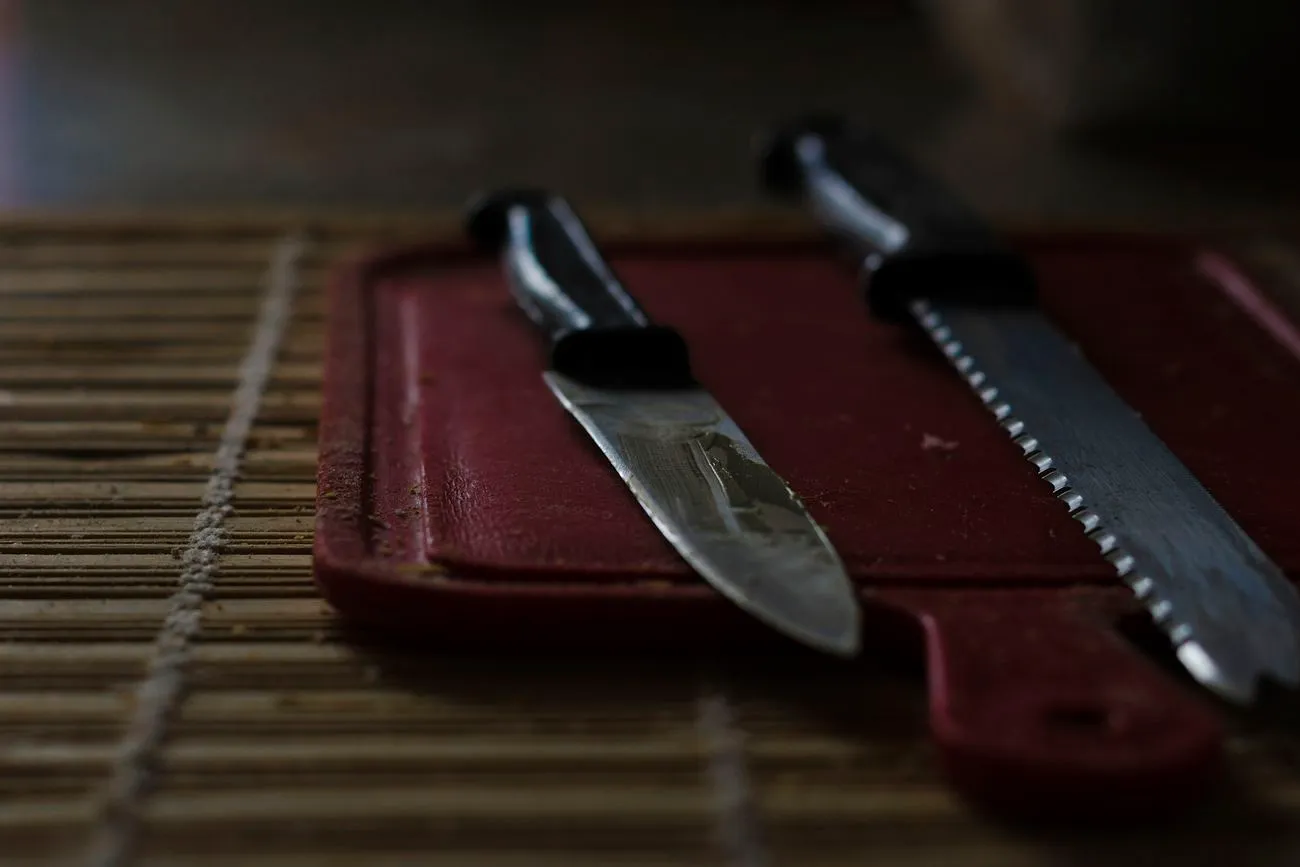
A good knife settles into the hand and stays there for years. You stop noticing it. That is how you know you chose well.
Most people buy a block of twelve and use two. Start the other way round. Buy the few you will reach for every day, buy them well, and let the rest wait until you miss them.
The three you need
A chef’s knife, 20 to 23 cm. It does nine jobs out of ten: onions, herbs, a chicken, a squash.
A paring knife, 8 to 10 cm. For the small work in the hand: peeling, trimming, coring a tomato.
A serrated bread knife, long, with teeth. It saws through crust and soft crumb without crushing either, and it handles ripe tomatoes too.
Everything else, from the boning knife to the cleaver, can come later, when a job asks for it.
Hold it before you buy it
A knife is a tool for the hand you have, so shop with your hand. Take the pinch grip: thumb and the side of your index finger on the blade just in front of the handle, the other three fingers around the grip. This is how good cooks hold a knife, and it is how you should judge one.
Then rock the blade on a board. It should move smoothly from heel to tip. Check that your knuckles clear the board when the edge is flat. Feel where it balances; most cooks like the weight near where the blade meets the handle. If it feels clumsy in the shop, it will feel clumsy at ten at night with a pile of onions.
Two numbers worth reading
Hardness, written as HRC on the Rockwell scale. Western knives usually sit around 56 to 58. They are a little softer, forgiving, easy to keep sharp at home. Japanese knives often run 60 or higher. They hold a finer edge for longer, and they are more brittle: a twist on a bone or a drop on tile can chip them.
Edge angle. Western blades are usually sharpened at about 20 degrees per side, Japanese blades at about 15. A narrower angle cuts more cleanly and asks for more care. Neither is better. They are different answers to how you cook.
The old rules, revised
You will read that forged blades always beat stamped ones, and that a full tang (the steel running the length of the handle) means quality. Both were truer once. Good stamped knives now cut beautifully, and a full tang mostly adds weight. Balance and fit in your hand matter more than either.
Steel matters too. Stainless resists rust and asks little of you. Carbon steel takes a wicked edge and darkens with use, and it will rust if you leave it wet. Ceramic is very hard and very sharp, and it can chip or snap.
A few makers worth knowing
Wüsthof, Solingen, Germany, since 1814. Solid forged Western knives that take years of hard use.
Zwilling J.A. Henckels, Solingen, since 1731. One of the oldest knife makers in the world. “Henckels” on its own is the company’s lower-priced line, not a separate older firm.
Global, made by Yoshikin in Niigata, Japan, since 1985. All steel, handle included, with a dimpled grip. Light and very sharp.
Shun, made by Kai in Seki, a Japanese city with centuries of sword making behind it. Hard steel, fine edges, handsome blades.
Victorinox, Switzerland. The maker of the Swiss Army Knife also makes a plain Fibrox chef’s knife that test kitchens keep recommending for very little money.
Keep it sharp
No dishwasher, ever. Hone often, a few strokes on a steel before you cook, to straighten the edge. Sharpen rarely, a few times a year. Cut on wood or plastic, never glass or stone. Dry the knife and put it away.
Look after it like this and the knife you bring home this year will still be the one you reach for in twenty. The handle wears to the shape of your grip. In time it fits no one else.